
Mineral Oil vs Beeswax for Cutting Boards: Which is Better?
I compare food grade mineral oil and beeswax wood butter to help you choose the best finish for your wooden cutting boards and butcher blocks.
I compare food grade mineral oil and beeswax wood butter to help you choose the best finish for your wooden cutting boards and butcher blocks.
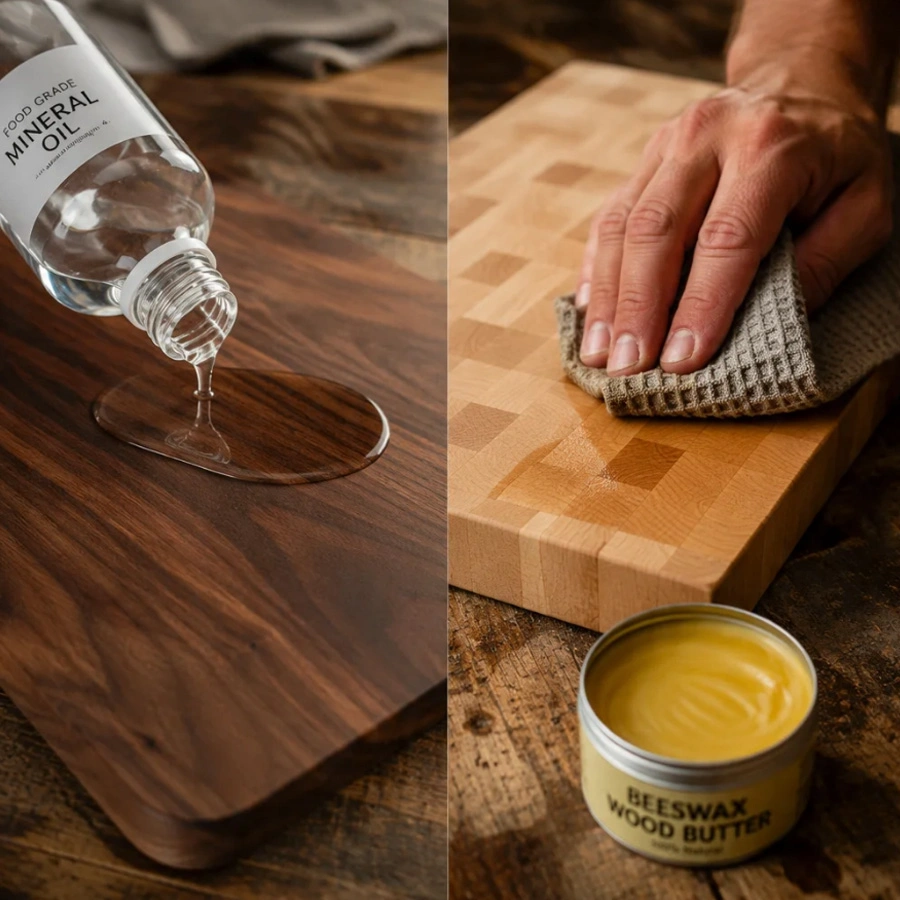
Over the past twenty years of teaching woodworking, one of the most common questions my students ask me is how they should finish their kitchen projects. When you build a beautiful end grain chopping block or a simple charcuterie tray, you absolutely cannot use standard furniture finishes like polyurethane or varnish. Those chemicals are toxic and will chip into your food when struck by a kitchen knife. You need a finish that is entirely food safe, easy to reapply, and highly protective. This brings us to the ultimate debate in the workshop kitchen space. You have to choose between food grade mineral oil and natural beeswax.
In this guide, I will break down exactly how these two finishes interact with wood fibers. I will explain why using only one of them might leave your project vulnerable to water damage, and I will share my personal method for combining them to create the ultimate waterproof seal. If you have ever experienced the frustration of a beautiful project cupping and splitting after a few washes, you understand how critical moisture control really is. In fact, failure to properly seal the wood is the leading cause of structural failure, and if you are currently dealing with a damaged board, I highly recommend reading my detailed tutorial on how to rescue and repair a severely warped wooden cutting board before it splits entirely.
Mineral oil is a clear, odorless, and tasteless liquid derived from petroleum. It is completely inert, meaning it will never go rancid, spoil, or support bacterial growth. This is a massive advantage over cooking oils like olive oil or vegetable oil, which will rot inside the wood fibers and make your kitchen smell terrible.
When I apply mineral oil to a dry wooden surface, the liquid acts like water soaking into a sponge. It travels deep into the capillary tubes of the wood grain. By filling these microscopic tubes with oil, I am essentially blocking water from entering later. If the wood is saturated with oil, it cannot absorb water from your sink. This deep penetration is what prevents the wood from drying out, becoming brittle, and eventually cracking down the middle. For anyone just starting out in this hobby, making simple flat boards is a fantastic way to practice applying oil evenly, which is exactly why I feature these types of projects heavily in my beginner woodworking plans collection designed for tablet viewing.
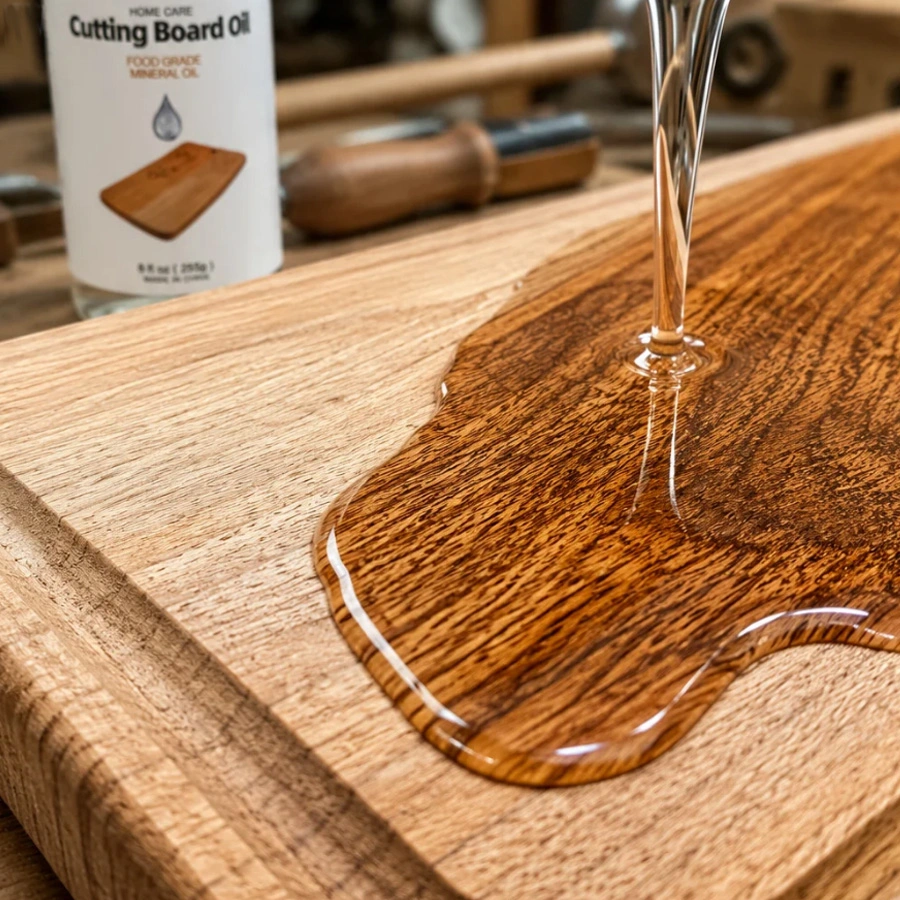
This is my top recommendation for a pure, unblended mineral oil. It is highly refined, completely food safe, and has a very low viscosity so it penetrates deep into hardwood grains effortlessly. Rated 4.8 stars by woodworkers.
Check Price on AliExpressThe biggest advantage of mineral oil is its penetrating power. It nourishes the wood from the inside. However, its main weakness is that it washes away relatively quickly. Because it remains a liquid inside the wood, hot water and dish soap will strip it out over time. This means you have to reapply it frequently to maintain the protection.
Beeswax is a natural wax produced by honey bees. In its pure form, it is quite hard at room temperature. If you try to rub a solid block of pure beeswax onto a cutting board, you will have a very difficult time getting an even coat, and it will not penetrate the wood fibers at all. It will just sit on top.
To solve this, woodworkers melt the beeswax and blend it with mineral oil to create what we call wood butter. This mixture is soft, creamy, and easy to apply with a cloth. When I apply wood butter, the mineral oil fraction sinks into the wood slightly, while the beeswax fraction stays on the surface. Once it cools and hardens, the beeswax forms a physical, waterproof barrier. Water will literally bead up and roll right off the surface. Just like you need to protect your delicate workshop tools by storing them properly, as I explain in my detailed guide to French cleat and pegboard organization, you must protect your kitchen tools with a durable wax shield.
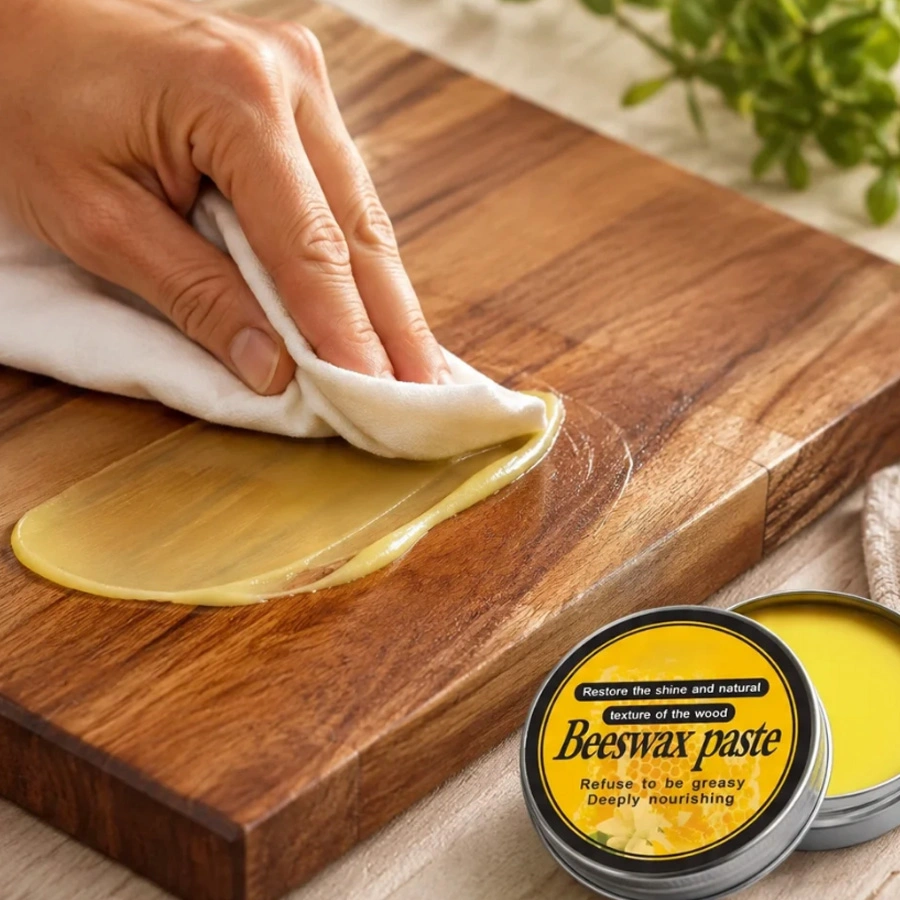
If you do not want to mix your own wax on the stove, this pre blended wood butter is exceptional. It contains the perfect ratio of pure beeswax and food grade mineral oil. With over 700 units sold and a 4.8 star rating, it creates a flawless waterproof seal.
Check Price on AliExpressI never ask my students to choose between oil and wax because the ultimate finish requires both. Here is my exact process for finishing a brand new project.
First, I flood the surface with pure mineral oil. I pour a heavy amount directly onto the wood and spread it around with my hands. I let it soak in for twenty minutes. If the wood looks dry in certain spots, I add more oil. I repeat this process until the wood simply will not absorb another drop. I wipe off the excess and let it sit overnight.
The next day, the wood is fully hydrated, but it needs a protective shield. This is when I apply the wood butter. I take a clean cotton cloth, scoop up a small amount of the beeswax blend, and buff it vigorously into the surface using circular motions. The friction from my hand generates slight heat, which melts the wax just enough to push it into the microscopic pores of the wood. I let it haze over for ten minutes, then I take a clean microfiber towel and buff it to a beautiful, silky shine. Mastering this two step finishing process is a fundamental skill, and it is a technique I feature heavily in my step by step illustrated tutorials for beginning woodworkers.
Both serve different purposes. Mineral oil is best for penetrating deep into the wood fibers to prevent drying and cracking. Beeswax is best used as a top coat over the mineral oil to create a waterproof barrier and leave a smooth finish.
I do not recommend using pure beeswax on its own because it is too hard to penetrate the wood. It sits on the surface. You should always use a mixture of mineral oil and beeswax, commonly known as wood butter.
For a brand new board, I apply oil every day for a week, then once a week for a month, and then once a month for the rest of its life. Whenever the wood looks dull or dry, it is time to reapply.
Protect your beautiful kitchen projects, then explore my full 23+ Woodworking Plans PDF bundle to start building professional quality furniture today.
Get The Complete Bundle ↗
Master Woodworking Educator · Since 2004 · 2,800+ Students Taught
I am a Master Woodworking Educator with over 20 years of hands on experience in furniture making. I have helped thousands of students from complete beginners to aspiring professionals build beautiful, functional pieces with confidence. My 23+ Essential Woodworking Plans PDF collection is trusted by students in over 50 countries. Learn more about my journey →
